
Death and Spring
Le Samyn and the GP Jean-Pierre Monseré: two March races that are also part of cycling’s tragic memory

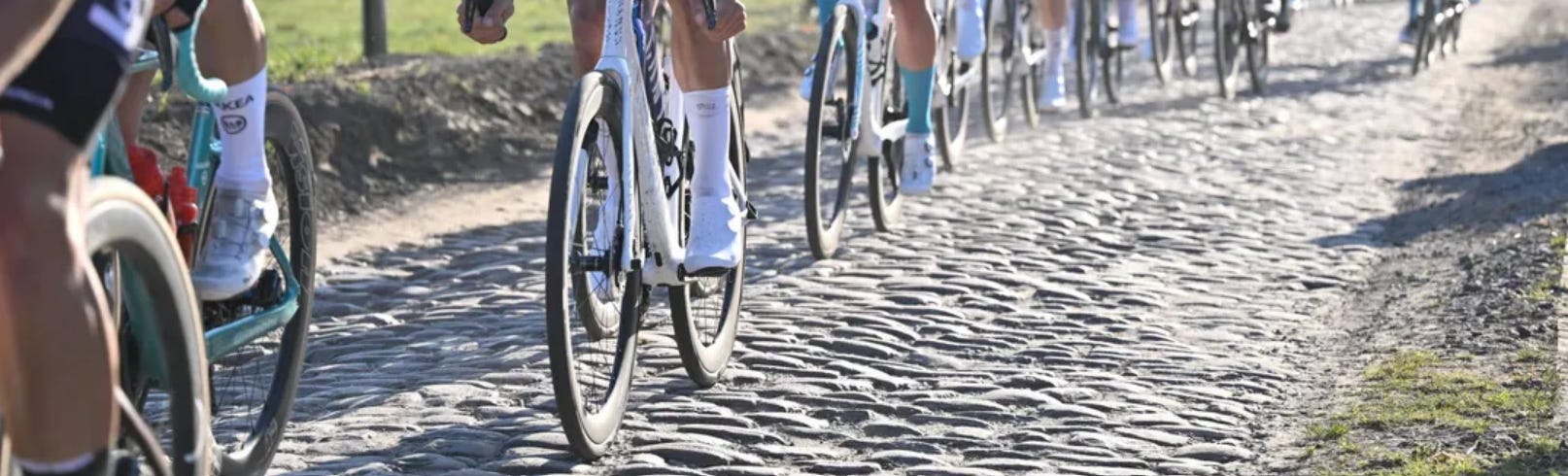
In these first days of March, when winter begins to retreat but the damp still clings to the ditches of Flanders and Wallonia, Belgium hosts the one-day race Le Samyn, renamed in 2025 as Ename Samyn for sponsorship reasons. It may be a second-tier event within the cobbled classics season, but it has a particular charm. Placed on the calendar just after the Omloop Nieuwsblad and Kuurne–Brussels–Kuurne, it acts as a kind of hinge between the solemn opening of Opening Weekend and the full-scale roll-out of the classics that will culminate in April. Perhaps because it arrives while my retina is still clear and I carry the involuntary fast of several long months without cycling of substance; perhaps because several editions have given us a nervous and open race, Le Samyn is one I feel especially fond of.
Its original name was not born of commercial interest, but of remembrance. Le Samyn honours José Samyn, a Franco-Belgian rider born in 1946 who died prematurely in 1969 after a crash in a race in Zingem. The event had begun as the Grand Prix de Fayt-le-Franc, but after his death the organisers decided to rename it to perpetuate the memory of the rider who had won its first edition. It is a gesture cycling has often repeated: turning the calendar into a sentimental map—though in recent years this has receded somewhat under the surge of turbocharged sponsorship across public life.
José Samyn’s career was brief, but among other victories he won a stage of the Tour de France in 1967 and a stage of Paris–Nice the following year. He stood out as a powerful rider and looked set to become a familiar contender in the classics and in breakaways, without lacking a notable turn of speed. His first name, José, might suggest Spanish family roots, though there is no documentary evidence to confirm this. What is certain is that being born in a border town, to a father and mother each from one side of the line separating France and Belgium, placed him in a very particular physical, economic, historical and symbolic space. It is flat, largely rural country, but densely populated thanks to industry and mining. It is also classics territory: draw a 30-kilometre-radius circle around his native Quiévrain and you encompass the routes of more than a dozen professional races. One of them, of course, is the race that remembers him, whose decisive section is held on a circuit around the town of Dour. Le Samyn has been characterised by a route combining narrow roads with several cobbled sectors, less famous than those of Flanders or the nearby Paris–Roubaix, but demanding enough to blow the race apart. It is no surprise that in these lands fast riders capable of surviving chaos tend to flourish.
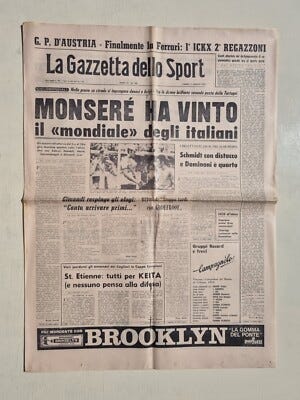
The name of José Samyn inevitably leads me to another March and another life cut short: that of Jean-Pierre Monseré. He too died in competition, in 1971, struck by a vehicle during the GP Retie. In 2012, a one-day race bearing his name, the Grote Prijs Jean-Pierre Monseré, was created in Roeselare, his hometown, and this year it will be held on 22 March. The temporal coincidence —two Belgian races in March, two tragic memories— confirms that the spring campaign is not only a sporting celebration but also carries a ritual patina of remembrance for the fallen. And if we widen the lens to other points in the calendar, we find further examples, such as Binche–Chimay–Binche, which has carried the subtitle Memorial Frank Vandenbroucke since the death of the turbulent and talented Belgian rider Frank Vandenbroucke in 2009 at the age of 34.
Returning to Monseré, his story is, if anything, even more heartbreaking than Samyn’s. Despite his youth, at the time of his death he was the reigning road world champion thanks to his victory in Leicester in the summer of 1970. He had claimed the rainbow jersey at just 22, becoming one of Belgium’s emerging stars, and some speculate that he might have made things difficult for Eddy Merckx, three years his senior. In any case, the so-called curse of the rainbow jersey—referring to the difficulty of winning regularly while wearing it—takes on a far more severe meaning here: Monseré found his death in it and did not even have time to defend it fully.
The Grote Prijs Jean-Pierre Monseré, now integrated into the professional calendar, maintains this commemorative dimension but has also found its own sporting space, often serving as a showcase for sprinters and young talents seeking their first significant results. For example, a 19-year-old Mathieu van der Poel climbed onto the second step of the podium when he was still a cyclocross prodigy and his incursions into road racing were occasional and on minor races.
When a race bears a person’s name, it is usually for two almost opposite reasons. One is to celebrate a great champion —either during their lifetime or in recognition of an extraordinary career— such as the Gran Premio Miguel Indurain, the Settimana Internazionale Coppi e Bartali, or the Cadel Evans Great Ocean Road Race, in honour of the only Australian to have won the Tour. The other is to fix in the calendar the memory of a tragic episode. There are even hybrid cases such as the Grand Prix Criquielion, created in 1991 in honour of Claude Criquielion upon his retirement, which he himself won in its first edition. But if the original intention was celebratory, his death in 2015 at just 58 inevitably tinted the race with a memorial tone that had not been part of the initial script.
The ease with which glory and tragedy intertwine is one of the factors that makes cycling a sport with such literary potential. The roads that applaud today may be scenes of mourning tomorrow. And the day after, of applause once more. Because despite the pain, life does not stop for those who survive; life pushes forward, even if reluctantly.